
On modern fuel-injected cars, a clogged engine air filter has little effect on fuel consumption, because the engine computer adjusts the fuel to match the air. What you lose is power: in tests by Oak Ridge National Laboratory for the US Department of Energy, cars accelerated 6 to 11 percent faster on a clean filter. Replace the filter at the interval in your service book, sooner on dusty roads.

Does a dirty air filter use more fuel?
On a modern car, hardly. Almost every car sold in Malaysia in the last twenty years has electronic fuel injection with closed-loop control: sensors measure the air going into the engine and the oxygen left in the exhaust, and the engine computer adds just enough fuel to match. When a clogged filter lets less air in, the computer simply adds less fuel. The mixture stays right, and so does the fuel consumption.

That is what Oak Ridge National Laboratory found when it tested this for the US Department of Energy in 2009. It ran three fuel-injected cars and one older carburettor car on a chassis dynamometer, first with clean air filters and then with filters clogged to the point where the car’s own “replace filter” indicator would come on. On the fuel-injected cars, clogging the filter had no significant effect on fuel economy.
What does a clogged filter cost you, then?
Power. A clogged filter limits how much air the engine can take in when you press the accelerator hard, and less air means less power. In the same tests, all the cars were slower with a clogged filter:
| Car in the test | Clean filter | Clogged filter |
|---|---|---|
| 2003 Toyota Camry, 32–129 km/h at full throttle | 17.24 s | 18.51 s |
| 2007 Buick Lucerne, 32–129 km/h at full throttle | 13.77 s | 15.45 s |
| 2006 Dodge Charger, 32–129 km/h at full throttle | 10.23 s | 10.84 s |
That is 7, 11 and 6 percent slower respectively; put the other way, the cars accelerated 6 to 11 percent faster on a clean filter. A follow-up Oak Ridge study published in 2012 came to the same conclusion: little fuel economy or emissions sensitivity to filter condition on modern cars, but a measurable acceleration penalty on every car with a clogged filter.
You notice that most when overtaking on a trunk road, joining a highway or climbing with a full car.
What about older cars?
On an older engine with a carburettor, the story is different. A carburettor can’t adjust the fuel the way a computer can, so a restricted filter makes the mixture too rich. The US Department of Energy’s guidance is that replacing a clogged air filter on a carburetted car can improve fuel economy and acceleration by a few percent.
Why replace it at all?
Because the air filter’s main job is protecting the engine. Dust that gets past a torn, worn or badly seated filter is abrasive. It wears the cylinder walls and piston rings, and it can foul the airflow sensor that the engine computer relies on.
The DuraFit air filter pack lists Up to 99% Dust Filtration, High Airflow for Engine Performance and Heat & Moisture Resistance.
When should you replace it?
Follow the interval in your car’s service book. Check it sooner if you:
- often drive on construction sites, estate or kampung roads;
- have driven through weeks of haze;
- notice the car feels slower than usual when you accelerate hard.
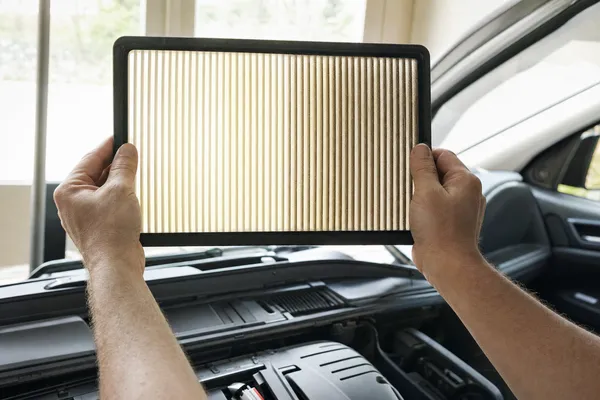
To check, open the air box (usually a black plastic box near the top of the engine, held by clips), lift out the filter and hold it up to a light. If light barely comes through the pleats, or you can see dirt, leaves or damage, replace it. Make sure the new filter sits flat in the box and the clips are closed all round, so no air can get around it.
Finding the right filter
Air filters are made for specific engines. Look up your car in the DuraFit catalogue, or see all DuraFit engine air filters. Car not listed? Send the make, model and year to the ServAuto BD team on WhatsApp.
Frequently asked questions
Will a new air filter improve my fuel economy?
Then why replace the air filter at all?
How often should the engine air filter be replaced in Malaysia?
Can I clean a paper air filter with compressed air?
Sources
- Oak Ridge National Laboratory for the US Department of Energy, 2009: Effect of Intake Air Filter Condition on Vehicle Fuel Economy (ORNL/TM-2009/021). osti.gov
- US Department of Energy and EPA, fueleconomy.gov: Keeping your vehicle in shape (air filters, fuel-injected and carburetted engines). fueleconomy.gov
- fueleconomy.gov: Air filter effects test summary, 26 Feb 2009 (acceleration times). fueleconomy.gov
- Oak Ridge National Laboratory, SAE 2012-01-1717: Effect of Intake Air Filter Condition on Light-Duty Gasoline Vehicles. osti.gov
- DuraFit air filter packaging (pack claims quoted word for word).


